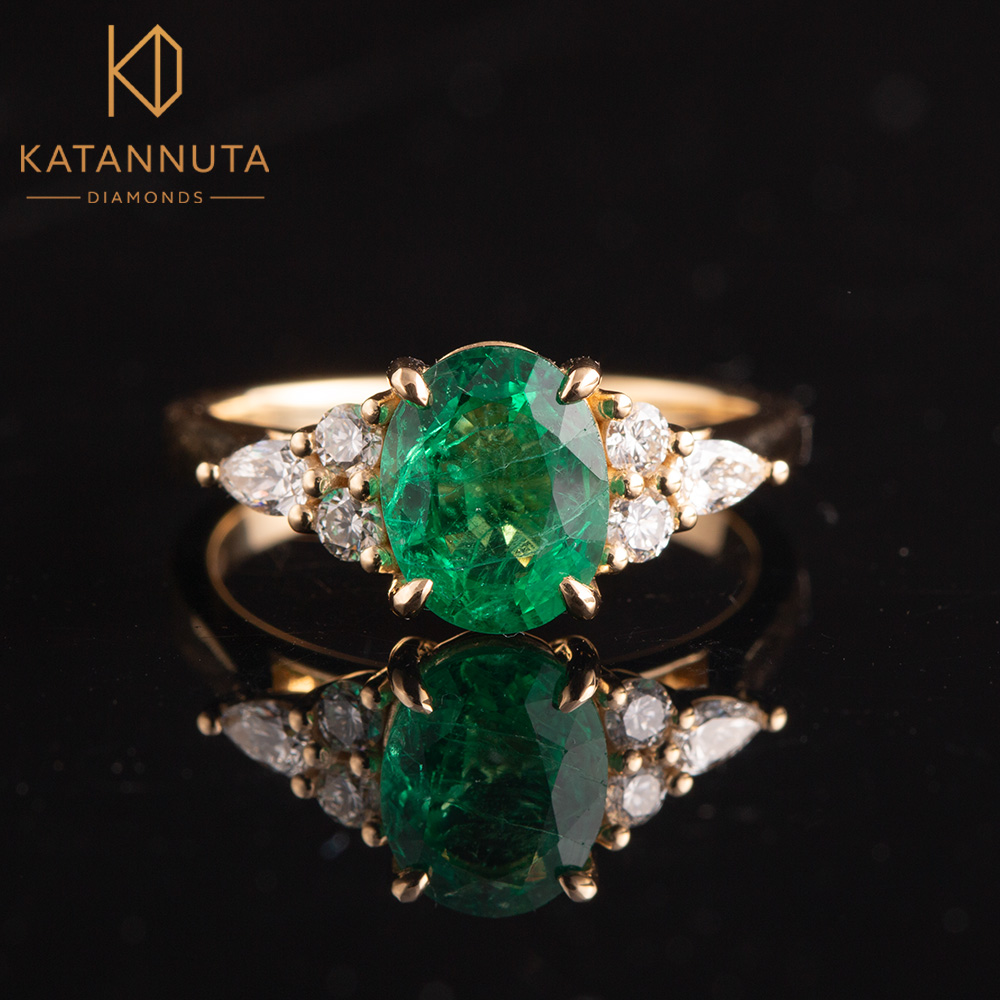
Ask 10 different people what their idea of a perfect engagement ring is, and you’ll get 10 different answers. In this social-media-driven era, you’ll see hundreds of potential ring designs that look incredible for your “I said ‘Yes!’” celebratory post, but many of these designs are almost certain to end in heartbreak when rings break, gemstones get damaged, or worse, fall out and get lost. Creating an engagement ring that lasts a lifetime requires paying attention to more than just its appearance.
The best engagement ring balances aesthetics and beauty with durability and practicality, ensuring your gemstone stays secure and your ring remains intact through everyday wear. At Katannuta Diamonds, we specialise in ensuring your engagement ring remains spectacular for decades to come. Here are the most important factors to consider when designing or purchasing your engagement ring.
1. Gemstones Suitable for Everyday Wear
Perhaps the topic we are most passionate about, we have 3 gemstones at the top of our suggested list for engagement rings. Diamonds, sapphires, and rubies are the most practical gemstones for daily wear due to their hardness and resistance to wear and tear. Diamonds have a hardness of 10/10 on Moh’s hardness scale, whilst rubies and sapphires both have a hardness of 9/10. Between these three gemstones, you’ve got options of virtually every colour of the rainbow. There are many less durable gemstones that, in our view, should never be set in an engagement ring, but are often seen in Instagram and Tik Tok posts.

Available in a wide spectrum of colours, sapphires are a perfect engagement ring gemstone.
2. Settings That Protect Your Stone
Once you’ve selected your perfect gemstone, you need to consider the setting of the gem/s. Natural gemstones are not cheap, so why take the risk of a setting that could lead to a lost or damaged gem? A sturdy setting is your gemstone’s first line of defence. Thin, skinny claws are very popular right now, but these can easily be damaged and bent or even break off (especially a concern with 9ct gold). When considering a claw setting for your stone, make sure that all corners or angular edges of the stone are covered and protected. We’re seeing too many designs showcasing pear, marquise and kite-cut diamonds with unprotected points. V-shape claws will provide the best protection for sharp, angular points.

This AI-generated image shows a popular pear-cut diamond design that is guaranteed to result in a broken diamond. There are a number of engagement ring designs we will never do – this is one of them.

V-shaped claws are perfect for protecting the delicate points of marquise cut diamonds.
3. Band width and structural integrity
Delicate bands are popular but generally aren’t strong enough to hold their shape. The more flimsy a shank is, the more likely it is to get bent out of shape, or snap. We recommend a minimum band width of 1.7mm for a constant band width, or 1.6 or 1.7mm at the top of the band to 2mm at the bottom of the shank for a tapered band. When you have a large centre stone, a wider band is recommended for both a balanced design and structural safety.
4. A gallery rail between claws
A gallery rail is a horizontal support beneath the stone that connects the claws. This detail prevents prongs from spreading and adds strength to the setting, enhancing both durability and elegance. A gallery rail doesn’t necessarily have to be a straight bar – it can be more ornate or even set with diamonds, in the case of a hidden halo. The important factor is making sure that the claws are connected somehow.

This solitaire diamond ring features a gallery rail that forms a heart shape in the basket of the ring.

Another example of a creative gallery rail that is both stylish and practical.
5. How many claws are enough?
Four claws are the minimum for most round, oval or cushion-cut stones, while six claws provide added security for larger stones. Fancy shapes with points should always have protective claws on each corner or tip. For cushion-cut stones, we always recommend a double claw over a single claw on the corners, due to the shape of the stones. For pear-cut stones, 3 claws can be considered safe if the stone size is small, but for large pear-cut stones, 5 claws are recommended.

For larger size round diamonds, 6 claws are recommended instead of 4 claws.
6. Choose a strong metal
Gold and platinum are our best suggestions for engagement ring settings. 18ct and 14ct gold will always be safer options than 9ct gold. For a white metal, we recommend platinum. Not only is it more cost-effective than 18ct white gold at the time of writing (December 2025), but it’s stronger and harder-wearing. We do not recommend silver as an engagement ring metal; it’s relatively soft and will wear down with time, often leading to the loss of gemstones.
Combine all of these for a design that will last a lifetime
The best engagement ring combines structure, strength, and style. At Katannuta Diamonds, our track record speaks for itself. Contact us if you have an engagement ring design in mind, and we’ll help you design a ring that combines the best options of gemstones, settings and metals, allowing your ring to last a lifetime.


![The ONLY reason to buy lab-grown diamonds [And it might not be the reason you think]](https://katannutadiamonds.co.za/wp-content/uploads/2023/11/Solitaire-lab-grown-diamond-ring-500x383.jpg)